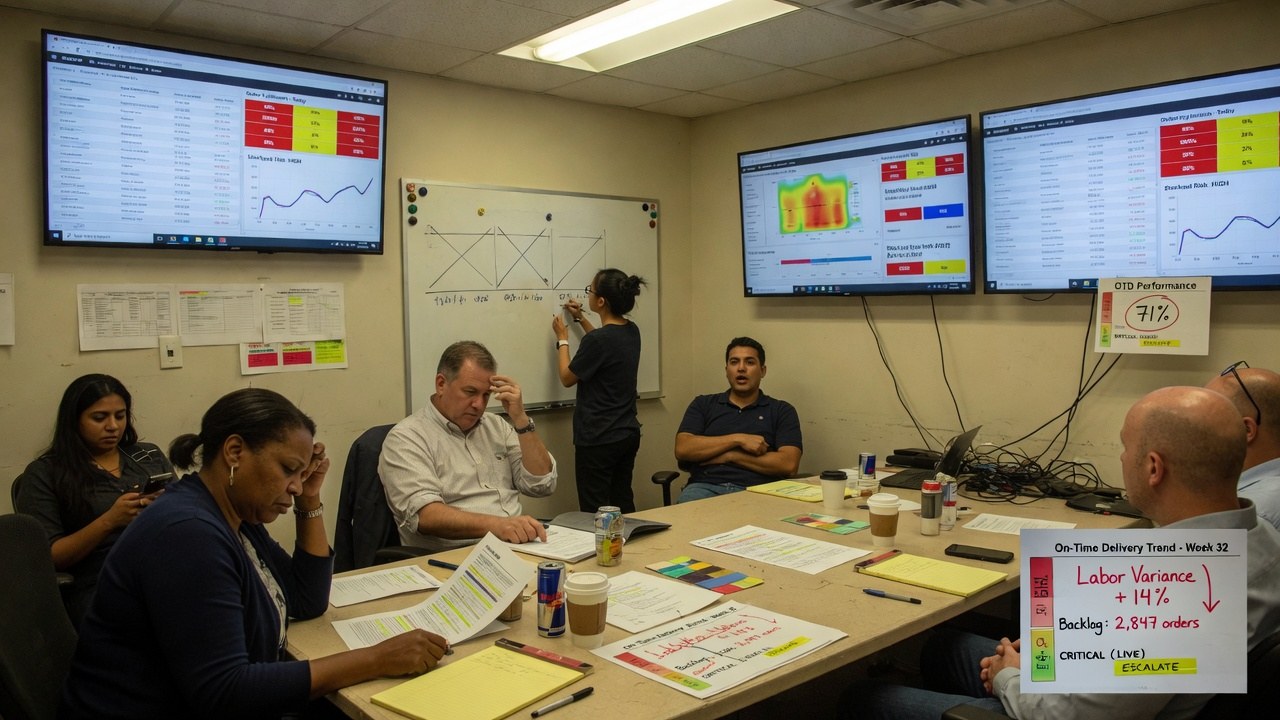
Automated franchise sales reporting and royalty reconciliation is the daily integration of point-of-sale, accounting, and operational data into a unified system that calculates royalty obligations, flags discrepancies in real time, and replaces manual spreadsheet consolidation with a live network-wide financial view.
| Capability | Manual Process | Automated Process |
|---|---|---|
| Reporting cadence | Weeks-long batch compilation in spreadsheets | Daily refresh with live network-wide scorecards |
| Data consolidation | Controller merges POS, accounting, and operational data by hand | Direct ingestion from 500-plus accounting, POS, and operations platforms |
| Royalty calculation | Custom rate structures tracked in spreadsheets; errors multiply | Calculated automatically per unit based on percentage, flat fee, or tiered rules |
| Variance detection | Profit leakage and COGS drift surface after the quarter ends | Threshold-based Green/Yellow/Red flags appear while still recoverable |
| Dispute resolution | Difficulty tracing royalty figures to specific invoices and payments | Every royalty figure traces to invoices and payments; discrepancies flagged immediately |
| Audit trail | Spreadsheet versions with limited history and timestamps | Logged adjustments, credits, and corrections with full version history |
The Operational Reality of Manual Franchise Sales Reporting
In a typical franchise network, point-of-sale data lives in one system, unit-level accounting lives in another - often QuickBooks - and operational metrics sit in a third. Consolidating these into a single view usually falls to a controller with a spreadsheet. Comparing one franchisee against the network average can consume a week of work, and the resulting deck is outdated the moment it is distributed.
Royalty reconciliation suffers under the same constraints. Franchisors track amounts due, amounts reported, and amounts received through manual spreadsheets, which makes it difficult to trace a royalty figure back to the specific invoices and customer payments behind it. When franchisees operate under customized rate structures - percentage of sales, flat fees, tiered models, or location-based variations - the complexity multiplies. Errors and delays become inevitable, and the trust between franchisor and franchisee erodes over time.
Profit leakage hides in this latency. Royalty under-reporting, COGS variance, and labor overspend rarely surface in time to act. Most network leadership teams find themselves fixing last quarter’s problem while the current quarter slips away.
What Daily Automation Changes
Automating the workflow replaces the weekly or monthly batch process with a daily refresh. Every location’s revenue, COGS, labor, and profit roll into a network-wide scorecard that updates automatically. Leadership can view a multi-location performance ranking that surfaces top and bottom performers immediately, rather than waiting for a controller to build a static report.
Thresholds are configurable to the brand’s own standards, not generic benchmarks. A franchisor can set Green, Yellow, and Red indicators based on the specific goals that matter to the network, so “on track” means what the brand defines it to mean. When a location drifts, it appears in the daily view while there is still time to intervene.
For franchisees, the same platform can deliver a unit-level performance view adapted to their login. They see their own data drawn from the books they already keep, which reduces confusion and gives them clarity without forcing them onto new software.
The Mechanics of Royalty Reconciliation
The core of royalty reconciliation is matching reported royalty statements with actual transactions and financial data. An automated system ingests data directly from franchisee accounting records and calculates royalties according to the customized rate structure assigned to each unit, whether that is a straight percentage of sales, a flat fee, or a tiered arrangement. Invoicing runs on a pre-set schedule - weekly, monthly, or on a custom timeframe - and payment status is tracked in real time.
When a payment comes in, the system automatically reconciles it against the reported amount. Discrepancies are flagged immediately. Because every royalty figure traces back to specific invoices and customer payments, disputes close faster. When adjustments, credits, or corrections are necessary, they move through controlled workflows where every change is logged with timestamps and version history, creating an audit trail that holds up to scrutiny.
That same live ledger can feed into FDD Item 19 substantiation. The system produces defensible unit-level averages, ranges, and audit trails formatted for a franchise attorney, which reduces compliance risk and accelerates disclosure preparation.
From Reporting to Action
Consolidation alone is not enough. The goal is to move from lagging indicators to leading action. Automated platforms can surface profit leakage in dollars and rank locations by recovery opportunity, so regional directors spend time where the financial impact is highest. A forecasting engine can project Goal versus Forecast versus Actual before the month closes, giving leadership a view of profit impact and trend while the numbers are still in motion.
When a metric crosses into underperformance, the workflow can identify the specific issue, recommend a corrective strategy, assign ownership to a named stakeholder - whether that is a CFO, a regional vice president, or a franchise business coach - and track the gap close day by day. Every fix that works becomes part of an institutional playbook, so the next time the same metric falls behind at another location, the network inherits the proven response rather than starting from scratch.
Integration and Practical Considerations
The most effective implementations do not force franchisees to abandon the tools they already use. Done-for-you integrations can connect 500-plus accounting, POS, and operations platforms into a single layer, pulling from the books franchisees already maintain rather than imposing a rip-and-replace mandate. Payment collection can remain flexible, accepting checks, credit cards, or ACH transfers, while integrating with central accounting software to keep reporting and reconciliation efficient.
Centralizing royalty data and reconciliation processes gives franchisors consistent visibility into network-wide performance. It replaces manual calculation with automatic precision, reduces the administrative load on both franchisor staff and franchisees, and creates the transparency that sustains long-term trust across the network.
For franchisors ready to close the four-to-six-week gap between field activity and financial insight, custom automation offers a practical path forward. At CEDX Systems, we build these exact workflows - connecting disparate accounting, POS, and operations systems into a unified daily reporting and reconciliation layer - so leadership can manage by current data instead of last quarter’s lagging report. Entry engagement starts at a $5,000 build plus $1,500 per month, structured around the specific tools and rate structures your network already uses.
Frequently Asked Questions
Why does manual franchise reporting typically create a four-to-six-week lag?
Point-of-sale data, unit-level accounting, and operational metrics usually live in separate systems. Consolidating them into a comparable view falls to a controller working with spreadsheets, a process that can consume a week of work and results in a static report that is outdated as soon as it is distributed.
How does automation improve royalty reconciliation between franchisors and franchisees?
An automated system ingests franchisee accounting data daily, calculates royalties according to each unit’s specific rate structure, and reconciles incoming payments against reported amounts in real time. Discrepancies are flagged immediately, and every figure traces back to the underlying invoices and customer payments so disputes close faster.
Can franchisees keep using their existing accounting and POS software?
Yes. Effective implementations use integrations that pull data from the books and systems franchisees already maintain, including 500-plus accounting, POS, and operations platforms, without requiring a rip-and-replace approach.
How does automated reporting help with FDD Item 19 compliance?
The live ledger of unit-level financial data produces defensible averages, ranges, and audit trails formatted for franchise attorneys, which reduces compliance risk and accelerates the preparation of disclosure documents.